How to learn Rust from scratch and understand ownership and the type system in 12 minutes
You can order the same kind of articles for your own video to boost it on YouTube and Google. Just message the Telegram bot @sat_sit_bot. Articles with your video embedded are written and posted by the bot itself — on popular topical sites (no ads). Your first 50 articles are free.
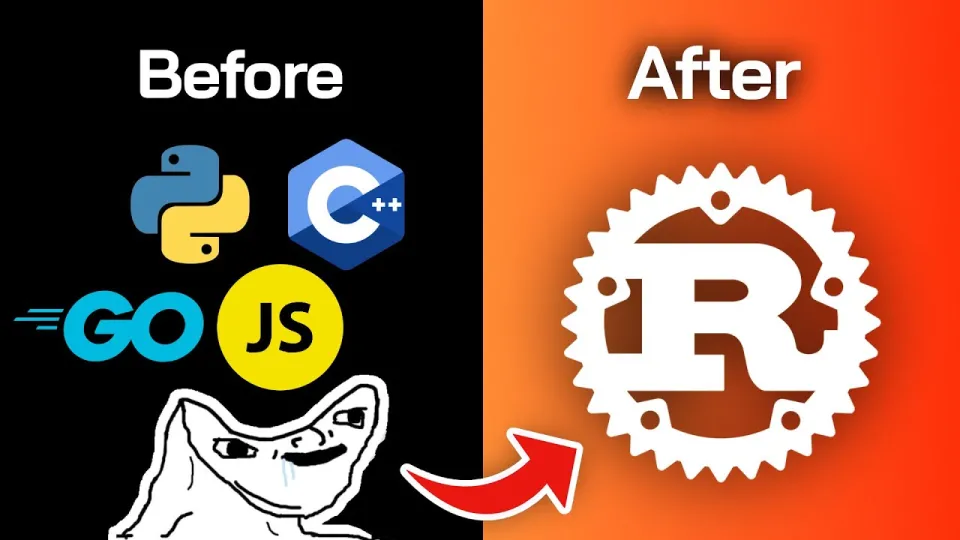
Rust is a compiled systems language that prevents memory errors at compile time through ownership, borrowing and a strict type system, so you can learn its core ideas without years of C++ experience. The fastest route is to stop treating it as a syntax to memorize and instead learn three rules: every value has one owner, references must always be valid, and every possible failure must be represented in a type. A structured roadmap helps here, and the Rust Live Accelerator waitlist and free Rust Job-Ready Roadmap is a good starting point for planning the path from first program to job-ready skills.
Why Rust code does not break at runtime
The central promise of Rust is that whole classes of bugs are caught before the program ever runs. In C and older C++ code, you allocate memory with `malloc` and release it with `free`; forgetting the second call leaks memory, and calling it twice corrupts the heap. Rust removes both calls from your code: when a variable goes out of scope, the compiler inserts the cleanup automatically, a pattern known as RAII (resource acquisition is initialization).
Ownership is the rule behind this. Each value has exactly one owner, and when that owner goes out of scope the value is dropped. If you assign a heap-allocated value to another variable, the value is moved rather than copied, and the original name becomes invalid. Trying to use it afterwards is a compile-time error, not a silent double free. This is why Rust needs no garbage collector: cleanup is deterministic and happens at a known point in the code, which matters for latency-sensitive software such as game engines, embedded firmware and network services.
Borrowing extends the model. Instead of moving a value into a function, you pass a reference with `&`, and the compiler checks that the reference never outlives the data. The rule is simple to state: at any moment you may have any number of immutable references, or exactly one mutable reference, but not both. That single constraint eliminates data races in multithreaded code, because two threads cannot mutate the same value simultaneously without synchronization.
The genius of Rust's type system
Rust's type system turns runtime surprises into compiler messages by making absence and failure explicit types. There is no `null` and no exception mechanism in the ordinary sense. A value that might be missing is an `Option<T>`, which is either `Some(value)` or `None`; a function that might fail returns `Result<T, E>`, which is either `Ok(value)` or `Err(error)`. The compiler refuses to let you use the inner value until you handle both cases, usually with `match` or the `?` operator.
This is where Rust differs sharply from JavaScript. In JavaScript, `0 == "0"` evaluates to true because loose equality coerces types, and `undefined` can appear anywhere at runtime. Rust has no implicit coercion between numbers and strings, so comparing mismatched types is a compile error. A JavaScript developer's habit of checking whether a value is truthy has no equivalent: you must destructure the `Option` and decide what to do.
Enums in Rust are far more powerful than in most languages, because each variant can carry data. Combined with pattern matching, they let you model states precisely: a network connection is `Connecting`, `Connected(socket)` or `Disconnected(reason)`, and the compiler verifies that every branch is handled. Adding a new variant later causes errors at every place that needs updating, which is exactly the safety net large codebases need.
A practical order for learning Rust step by step
Learning Rust works best in a fixed sequence, because later concepts depend on earlier ones. Follow this order rather than jumping between topics:
- Install the toolchain with `rustup`, then create a project with `cargo new hello`. Cargo handles building, dependencies and testing, so you rarely touch the compiler directly.
- Learn variables, mutability (`let mut`), functions and the basic scalar types. Note that variables are immutable by default, which is the opposite of most languages.
- Work through ownership and moves on `String` versus `&str`, since heap-allocated strings make the difference between owning and borrowing obvious.
- Add references and slices, then try to trigger borrow-checker errors on purpose. Reading the error messages is a skill in itself, and `rustc` usually suggests the fix.
- Learn `struct`, `enum` and `match` before traits, then move to `Option` and `Result` and the `?` operator.
- Only after that, take on lifetimes, generics and traits. Lifetimes are annotations that describe relationships between references, not a separate memory management system.
A realistic pace for a developer with experience in another language is a few weeks to basic fluency and a few months to comfortable, idiomatic code. The compiler is strict, but it is also the most patient teacher you will get: each rejected program comes with an explanation.
Typical doubts from developers coming from other languages
Most hesitation about Rust comes from comparisons with languages people already know. The first is the claim that Rust is only for systems programming: in practice it is used for command-line tools, web backends, WebAssembly modules and infrastructure software, and many developers arrive because the projects they rely on are written in it. Contributing to those projects is a legitimate and effective learning goal.
The second doubt concerns C++: modern C++ already offers smart pointers such as `std::unique_ptr` and `std::shared_ptr`, which delete objects when they leave scope, so the manual `malloc`/`free` comparison describes older C-style code rather than current practice. The real difference is enforcement: Rust's ownership rules are checked by the compiler everywhere, including references and threads, while C++ relies on conventions and discipline.
The third is readability. Dense Rust with heavy generics and lifetime annotations can be hard to read, and developers used to Go's deliberately plain style often find it noisy. The counterweight is that the noise usually encodes guarantees you would otherwise verify by testing and code review. Null pointer bugs are another recurring theme: languages like Java have largely solved them through discipline and annotations, but Rust solves them structurally, since a `None` cannot be dereferenced by accident.
Where to go after the basics
Once ownership, borrowing and `Result` feel natural, the next steps are traits and generics for abstraction, closures and iterators for data processing, and modules and crates for organizing code. From there, pick one domain: async with Tokio for network services, `serde` for serialization, or `no_std` for embedded targets. Building one small complete tool, such as a command-line utility that reads files and handles errors with `?`, teaches more than several tutorials.
Summary
Rust is learnable in a short session at the conceptual level: one owner per value, references validated by the compiler, and failures expressed as types. The Let's Get Rusty video breakdown compresses these two pillars, memory safety without a garbage collector and an expressive type system, into roughly 12 minutes, which makes it a solid first pass before hands-on practice. The remaining work is repetition with the compiler as your reviewer. If you want structure and a career path rather than scattered tutorials, join the Rust Live Accelerator waitlist and use the free roadmap to plan the next few months.
Key takeaways
- Rust has no garbage collector: memory is freed when a value goes out of scope, which removes manual malloc/free calls.
- Ownership allows exactly one owner per value at a time, so use-after-free and double-free become compile-time errors rather than runtime crashes.
- Borrowing lets you pass references instead of moving values, with a rule of many immutable references or one mutable reference.
- Rust's type system uses enums like Option and Result to force handling of missing values and errors instead of null pointers and exceptions.
- The Let's Get Rusty breakdown covers these ideas in about 12 minutes across two parts: memory safety and the type system.
Questions & answers
Do I need to know C or C++ before learning Rust?
No. Rust does not require prior systems programming experience, and the compiler explains ownership errors in plain language. Knowing C or C++ helps you appreciate what the borrow checker prevents, but it can also bring habits, such as manual memory management, that you have to unlearn.
Why does Rust reject my code that looks correct?
The borrow checker rejects code where a reference could outlive its data or where a value is used after being moved. These are usually real bugs that would appear as crashes or corruption in other languages. Read the compiler's suggestion, often it proposes cloning, restructuring the scope, or passing a reference instead of moving the value.
Is Rust harder than JavaScript or Python?
Rust has a steeper initial curve because the compiler enforces rules that dynamic languages check at runtime or ignore. Once ownership and `Option`/`Result` click, day-to-day code is comparable in difficulty. Developers report that the hardest part is the first two weeks, not the whole language.
How long does it take to become productive in Rust?
For a developer with experience in another language, a few weeks of daily practice is enough for small tools and basic contributions, and a few months for comfortable idiomatic code. Progress depends more on writing complete programs than on watching tutorials, so build something small and let the compiler guide you.